Summer's end, and a modern night of the dead
Samhain
Samhain is an Irish quarter day at the start of winter. The eightfold Wiccan wheel around it is a twentieth-century calendar. Keep the history honest, and keep the supper kind.
Where the feast comes from
Samhain is an Irish quarter day. Medieval Irish sources place it at the turn into winter, opposite Bealtaine at the start of the summer half, with Imbolc and Lughnasadh holding the midpoints of those halves. The name is commonly explained as summer's end. Literature sets assemblies, feasts, and uncanny meetings there; one famous passage, in the wooing of Emer, says the mounds are open at Samhain. That is story, and story is evidence of what medieval Ireland thought worth telling, not a surviving order of service from a single prehistoric temple. Later folk custom in Ireland and Scotland includes, in various districts and centuries, fires, food, games, and divination. Christian All Saints on the first of November and All Souls on the second sit on the same days and have braided with the older season for a very long time. A slogan that the church simply stole the feast, or a slogan that nothing pre-Christian was there, both flatten a long argument into a sticker.
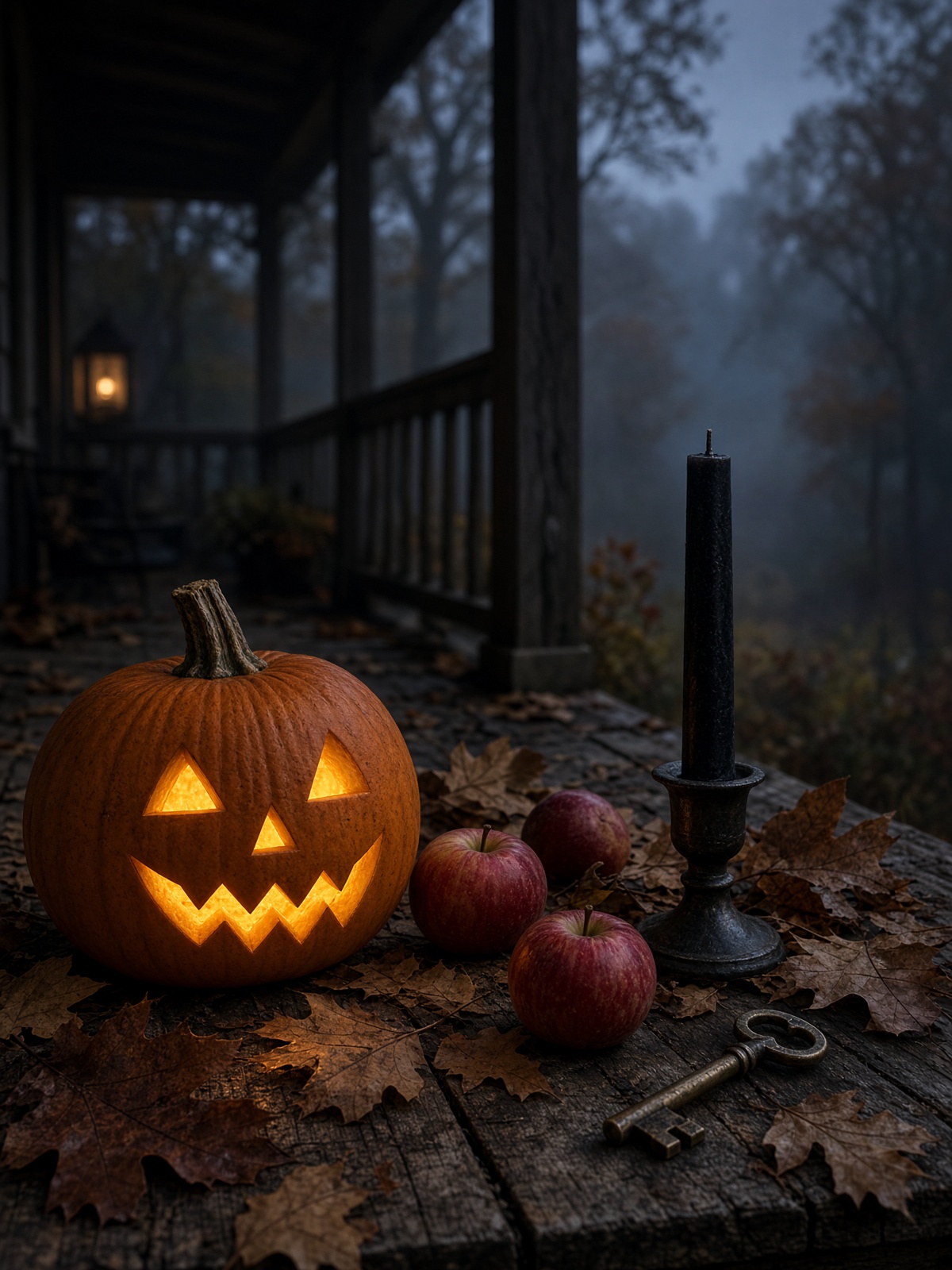
The eight-festival Wheel of the Year is a different object. It is a twentieth-century synthesis. Gerald Gardner's mid-century witchcraft, later public Craft associated with Alex Sanders and others, and the calendars popularized in books through the middle of the century and after, set the four Insular quarter days beside the solstices and equinoxes and called the result a ritual year. That year is meaningful. It is not unbroken ancient Wicca. Wicca itself is not ancient. It is also not 'what the Celts did.' The peoples called Celtic were not one parish with one script, and the Gaelic quarter days are better attested as a seasonal frame in Ireland than as a pan-European pagan liturgy. Modern Samhain, as an ancestor night and a last harvest, is a contemporary emphasis you may keep if you say it is contemporary. Jack-o'-lanterns are a later custom, turnips in parts of Ireland and Britain, pumpkins in America. They are cheerful and optional and not a druidic law.
How it is kept now
In many pagan households now, Samhain is the night of the beloved dead, of finished harvests, and of a deliberate look at what the year cost. That is a good use of a darkening season if you are actually in a darkening season. It is also a night when grief gets marketed. You do not have to hold a séance, own a skull, or contact anyone. Speaking a name aloud, setting a photograph, and eating a meal is a complete observance. Do not try to compel the dead, interrogate them about secrets, or prove a haunting. Memory is not a hotline. If your grief is fresh or complicated, a ritual is not a substitute for a friend, a counselor, or a community that can sit with you past the aesthetic. You may skip the ancestor work and only cook. Cooking is historical enough.
Halloween as a civic holiday can be left alone to be Halloween: children, sugar, jokes about fear. You can turn the porch light on for them and keep your quieter supper after. You can also ignore both and go to bed. Nothing in this night punishes nonparticipation. If you work retail through the season, your observance may be a glass of water after the shift on November second, shoes off, one name said. That counts. Do not use the dead as props for a curse, and do not send 'Samhain justice' at a living enemy. The Wilde Altar does not teach coercion of the living or the dead.
North, south, and the weather you actually have
In the northern temperate year, Samhain sits near the last days of October and the first of November, when many European landscapes are losing leaves and bringing animals in. If that is your weather, the old images will fit without forcing. If you live in a northern place where October is still warm, or already snow, trust the street outside more than a British poem. The date can stay as a cultural feast while the decorations tell the truth. Pumpkins rot differently in different humidity. Let them.
In the southern hemisphere, late October is spring, not the dying year. Many practitioners swap the seasonal rites and keep Samhain at local autumn, often the end of April into May. Others keep the northern dates because a tradition, a coven, or a family online meets then, and they add a local gesture so they are not pretending Adelaide is Kerry. Both are choices. Neither is more advanced. A strict swap can still be a British diagram turned upside down: southern harvests do not always fall on the inverted date. If your first cold, your actual slaughter or slaughter-free market, or your Day of the Dead community falls elsewhere, you may let that be the heavier night and keep Samhain as a smaller candle. Local land outranks a weather script written for an island you may never have walked.
An altar that can be put away
A photograph, a stone, a candle or a lamp, a plate that will be eaten or washed. Dark cloth if you have it, or the table as it is. Flowers from the shop if they are in season where you are, not a protected plant pulled from a verge. A list of names is enough. If names would expose you in a shared house, keep the list in your head and let the extra cup be 'for anyone who is not at this table.' Avoid skull kitsch unless you already like it and can explain it to a child without a lecture. Avoid photographs of the dead who would have hated to be in a pagan rite, or include them with a courtesy that fits who they were: some ancestors want a church candle and no speech about witches. Love can look like not drafting them into your aesthetic.
Food on an ancestor plate should not be left where dogs can be poisoned. Chocolate, grapes, onions, xylitol, and alcohol are a hard no for a bowl on the floor. Better: you eat the food, or you compost what is safe to compost, or you put out plain bread for the length of the meal and then bring it in. Do not leave mold as an offering and call the mold a sign. Clean water in a cup is a better offering than a spill. When the night is over, wash the dishes. The dead, in this house, do not require a dirty kitchen.
Solitary, and with chosen family
Alone, set one plate for yourself and, if you want, a smaller one that you will also eventually eat or clear. Say the names you can say without performing. Sit the length of a cup of tea. If the silence gets sharp, turn on a familiar song that the person loved, or a song you love, and let that be the visit. You do not have to cry to prove the dead matter. You do not have to be cheerful either. End at a time you set, so grief has a door out of the ritual and back into the week, where it will anyway live.
With chosen family, each person may bring one name, or pass. No one owes the story behind the name. Agree before dinner that this is not a night for surprise confrontations, uninvited spirit work, or jokes at the expense of someone who is mourning. A child's role can be setting spoons, not being psychic. If your blood family is the dangerous table, chosen family is the real one, and a solitary plate is also a real one. Romance is irrelevant to this feast. The dead are not a fertility charm. They are the people missing from the chairs.
The table, including if you do not cook
The recipe below is a pan of apples, small and sweet and possible in a single saucepan. It is food. It will not heal grief or speak for the dead. If you do not cook, a piece of bread and butter is enough. Put it on a plate. Eat it slowly. That is a Samhain supper. If you buy a pie, that is also a supper. The moral content is the attention, the name if you have one, and the fact that you fed a living body, which is the body you are responsible for tonight.
Apples are traditional in some later British and Irish folk divination, and you may skip the divination. Do not bob for apples in a way that excludes someone who cannot play, and do not treat a peeling thrown over the shoulder as a binding answer about marriage. The year is allowed to stay unknown. Eat the apple. Wash the pan. Lock the door. Tomorrow is an ordinary November day, or an ordinary late-autumn day in whichever month your land calls this feast.
Correspondences, labeled as such
| Northern cultural date | Evening of 31 October into 1 November. The weekend near it is a respectable modern compromise. |
| Southern seasonal choice | Local autumn, often 30 April into 1 May, if you swap the wheel to match the land. Keeping the northern date is also a choice. |
| Historical core | Irish quarter day and start of the winter half. Not a transcript of one ancient rite, and not the whole Wheel by itself. |
| Modern theme | Names of the dead, finished harvest, a meal. Memory, not compulsion. |
| Table | Bread and butter is a complete feast if you do not cook. |
An original rite
Materials. A plate of food you will actually eat, or bread and butter if that is the meal · A second, smaller plate or a napkin, optional, for the names. It must be cleared the same night · A candle or tea light, or a lamp if flame is not allowed in the building · A list of names on paper, or in your memory if paper is not safe · A cup of potable water or tea, and a clock so the rite has an ending
- 1Set the table for the living first. You are not an afterthought to your own rite. Put the food out. If there is an extra plate, keep it small and free of anything poisonous to household animals.
- 2Light the lamp or candle safely. Speak the words of the rite. Then read or say only the names you have chosen. After each, you may add one fact, or nothing. People may pass.
- 3Do not ask the dead for lottery numbers, verdicts, or permission to harm someone. If you feel pressure to turn the meal into a summoning, stop and eat instead. Eating is the loyal act.
- 4Eat the meal while it is good. Talk about the dead as people, not as oracles, or eat in quiet. Children may talk about costumes. That is not a desecration.
- 5At the time you set, say that the visit is over for tonight. The dead do not lose your love because the dishes start.
- 6Clear the extra plate. Eat that portion or store it as ordinary leftovers, or compost what is safe. Pour extra water on a plant or down the drain. Do not leave sweets where a dog can find them.
- 7Wash up, put the light to its ordinary setting, and do one small kindness for a living person or for your own body before bed. A text, a glass of water, the taking of a needed medicine. The living are the rest of the rite.
I set a place for a name, not a command. The dead are not on call. I feed the body that is here. When I close the door, the love does not have to leave.
Close. Extinguish the flame. Say the names are released from the table and the room is only a room. Wash the plates before sleep if you can. A clean sink is a closed gate.
A practical action. On one ordinary day this week, do a practical thing the dead do not need and the living do: pay a bill, call a friend, tend a grave if you have one and it is wanted, or give a small amount to the living who are short. Skip any of this if money or grief makes it too much. The supper already counted.
A table
- 1 eating apple, cored and sliced, or 1 cup unsweetened applesauce
- 1 teaspoon butter, or neutral oil if you do not eat dairy
- 1 teaspoon honey or brown sugar, or skip the sweetener
- A pinch of salt
- A pinch of ground cinnamon, or a strip of washed orange peel, or nothing
- 1 slice of bread, or 2 tablespoons of rolled oats
Method
- 1Warm the butter or oil in a small pan over medium-low heat.
- 2Add the apple, salt, and cinnamon or peel. Cook, stirring, until the apple is soft, about 8 minutes. Add a spoon of water if it sticks. If you are using applesauce, simply heat it through with the salt.
- 3Stir in honey if you want it. Toast the bread, or stir the oats in with a splash of water and cook another 2 minutes until soft.
- 4Eat it hot, seated. If you do not cook, butter a piece of bread and eat that instead. Wash the pan. The feast is over either way.
Questions
- Which names do you actually want at the table, and which are you adding for atmosphere?
- Are you in the northern dark of the year, the southern autumn, or a season that matches neither script?
- What will you do for a living person this week that is not a performance of grief?
Sources and further reading
- Encyclopaedia Britannica, Samhain. A starting point for the feast's date, its winter turn, and its braid with All Saints. Read it beside longer history, not as a complete ancient script.
- Encyclopaedia Britannica on Celtic religious festivals: Beltine and Samhain as the halves, Imbolc and Lughnasadh as the quarters between.
- Encyclopaedia Britannica, modern Paganism, on the eight sabbats of the Wiccan wheel as a modern calendar, including the southern-hemisphere habit of shifting dates.