The dark seed
New Moon
A new moon is the Moon nearly between Earth and Sun, mostly unlit from where we stand. Use it to write one beginning small enough to survive the week. No sign is promised.
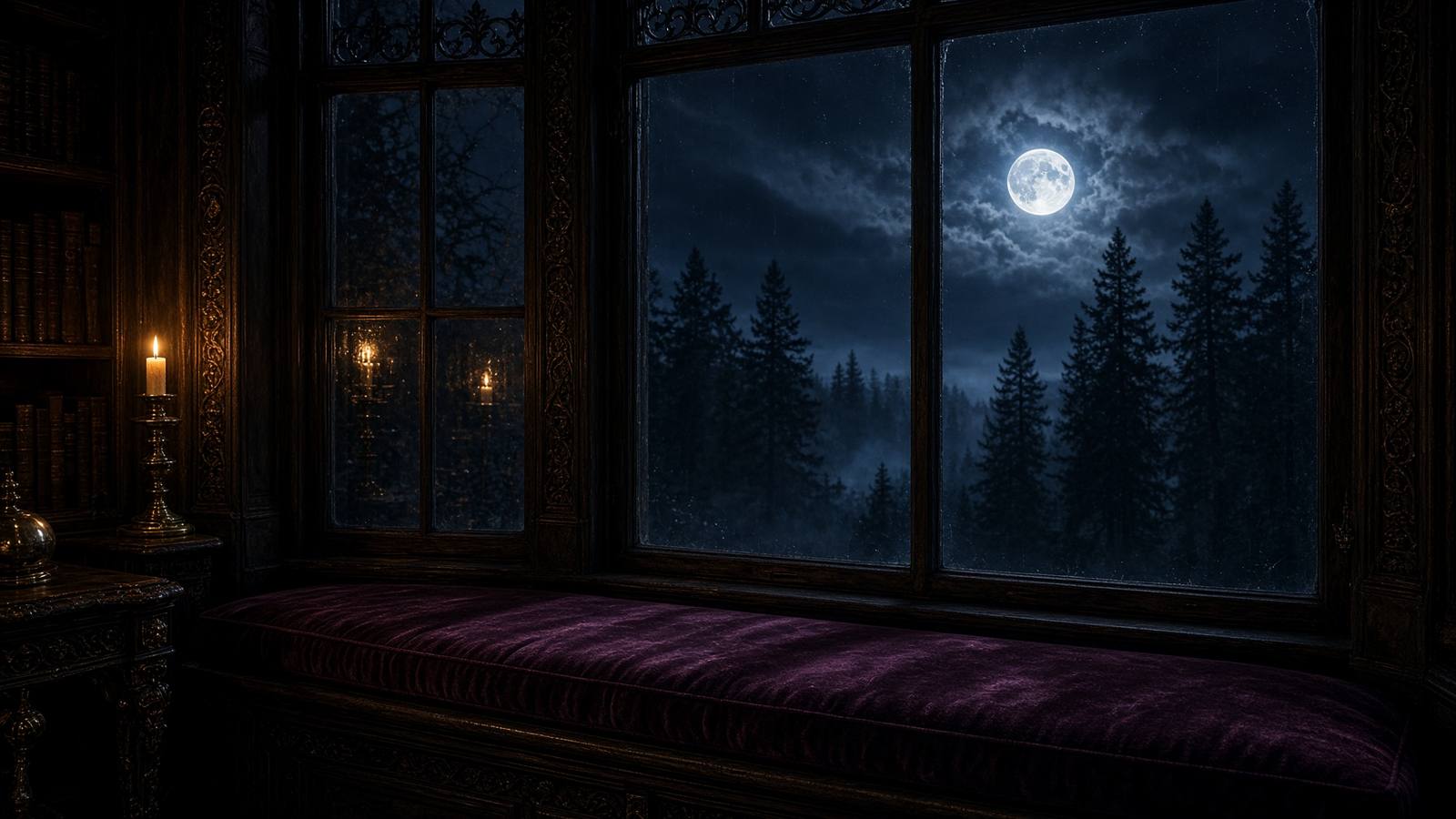
The sky, without precision theater
Astronomically, the new moon is the moment when the Moon and the Sun share roughly the same direction in the sky, so the side of the Moon that faces us is in shadow. You usually cannot see it. A thin crescent a day or two later is already waxing, and people still call that evening 'the new moon' in ordinary speech. Both uses are fine if you know which one you mean. This house does not ask you to hit the exact minute of conjunction. A calendar, a planetarium app, or the simple fact of a dark evening is enough. Weather, time zones, and a night shift will move what you can witness. The phase is not offended.
Darkness here is a lighting condition, not a moral one. Many cultures have told stories about a hidden moon, a swallowed moon, or a moon that goes to rest. Those stories are local literatures. Greek myth, for one, gives Selene a chariot and a long night's work, which you can read as poetry at the Theoi Project without making Greek cosmology the mechanism of the sky. The Wilde Altar uses the new moon as a pause before a visible return of light. It is a good night to start something on paper. It is a poor night to swear that the dark itself has chosen your fate.
What a seed on paper is for
The work of this phase is one beginning, written down, small enough that a tired person could touch it within two days. Not a new personality. Not a twelve-week overhaul designed to impress a future self who does not have to do the dishes. A seed can be a sentence: I will open the letter; I will ask for the shift change; I will put the seeds I already bought into the pot I already own. Write the limit beside it. What you will not promise matters as much as what you will attempt. A new moon rite that demands a total life rewrite is just anxiety in a nicer dress.
If you are grieving, ill, or in a stretch of mere survival, the honest seed may be rest, or one meal, or no new project at all. Beginning can mean beginning to stop. You do not owe the sky a glow-up. If your last new-moon intention is still unfinished, you may tend that one instead of planting a rival. Gardens do not thrive on a fresh packet of seeds every week and no watering. Treat the paper as a draft. Tomorrow you are allowed to cross a line out. Revision is not failure of faith. It is how living things stay alive.
Keeping it in an ordinary week
Put the paper where you will meet it again: inside a book you actually open, under a mug, in a note on your phone with a reminder two days out. Do not bury it in the garden unless you truly want the words to become compost and you are sure the ink and paper will not become trash in the soil. Do not burn it as a test of courage unless fire is legal, safe, and you have already copied the one line you need. Spectacle is optional. The next ordinary action is the rite continuing.
If you share a room and privacy is thin, type the seed and lock the note, or write it in a language, shorthand, or dullness that does not invite questions. 'Call dentist' is a complete spell. You do not have to look like a witch for the week to count. Skip the rite if the night is unsafe or you are too tired to be kind to yourself. The Moon will be new again. Nothing in this practice binds another person, and nothing in it replaces a plan, a budget, or a friend.
Correspondences, labeled as such
| Sky, loosely | The unlit Moon, or the first evening you notice the dark of it. Exact conjunction is optional. |
| Human use | One written beginning. A draft, not a vow you must bleed for. |
| Color, if you want one | Black, undyed cloth, navy, or the dark you already own. Color is a mnemonic, not a law. |
| Household ally | Paper and a pen. A locked note on a phone if paper is not private. |
| What it is not | Not a command to reinvent your life, and not a night when the unseen world owes you a sign. |
An original rite
Materials. A scrap of paper, or the back of an envelope, or a locked note on your phone if paper is not private · A pen or pencil, or your thumb if you are typing · A candle or tea light, or a lamp you can leave as it is if open flame is forbidden where you live · A cup of water you would already drink, or the tea you were going to make anyway · A book you actually open, or a clean saucer, or a drawer that is yours, to hold the paper afterward
- 1Make the room as quiet as your safety allows. If you need the lights bright in order to feel safe, leave them bright. A new moon is not a test of how much dark you can endure.
- 2On the paper, write one sentence that starts 'I am willing to start' and keep it smaller than a life overhaul. Under it, write the first physical step and the date you will touch it, within two days.
- 3Beneath that, write one limit: what you refuse to promise. If the true seed is rest or 'no new project,' write that without decorating it.
- 4Read the lines once. Speak the words of the rite if you want a voice in the room. You do not have to believe anyone unseen is listening.
- 5Fold the paper. Set it in the book, under the saucer, or in the drawer. If you used a phone, set a reminder for the step and leave the note unposted.
- 6Drink the water because you have a body, not because the night purified it. Moonlight does not disinfect water, and this cup was never asked to.
- 7Leave the fold alone until you do the step or until the crescent, whichever comes first. If the plan feels wrong in daylight, rewrite it. A seed is allowed to be corrected.
Small is not the same as false. I write one beginning and no more. The dark does not owe me a sign. I will meet this paper in ordinary light.
Close. Put the room back to its usual light. Say, aloud or inward, that the rite is over and the room is only a room. Wash the cup when you would have washed it anyway.
A practical action. Within two days, do the first physical step, even if it is only opening the document, setting the appointment, or deciding in daylight that the seed should be composted and rewritten.
Questions
- What beginning is small enough that a tired version of you could touch it within two days?
- What are you tempted to promise the dark that you have no business swearing?
- If this seed is still unfinished at the next new moon, will you tend it, revise it, or let it go?
Sources and further reading
- Encyclopaedia Britannica, for the Moon as an astronomical body. Phase names in ritual are a human calendar laid over that geometry, not a claim of observatory precision.
- NASA eclipse resources. Included so sky-work stays physical: the Moon's light is reflected sunlight, and ritual timing does not require a minute-by-minute ephemeris.
- Theoi Project, Selene and other Greek lunar figures, as one culture's poetry about the Moon rather than a universal mechanism.