Lugh's assembly and the loaf-mass
Lughnasadh
Lughnasadh is an Irish harvest feast tied to Lugh and to Tailtiu's games. Lammas is the Anglo-Saxon loaf-mass. Related themes, different names. First fruits means whatever is actually first where you live.
Where the feast comes from
Lughnasadh, around the first of August, is the Irish quarter day that opens the harvest side of the year. Medieval accounts tie it to the god Lugh, many-skilled, and to the funeral games he established for his foster-mother Tailtiu at Tailtiu, an assembly with games, markets, proclamations, and the first of the grain or the first fruits in a pastoral and farming calendar. It is not a simple story in which a sun god dies for the crop. Lugh is not a one-note vegetation sacrifice, though later writers sometimes sanded him into that shape. Read him as the sources paint him if you read him: skilled, political, bright, embedded in a particular literature. Do not draft him as a generic husband for a fertility rite.
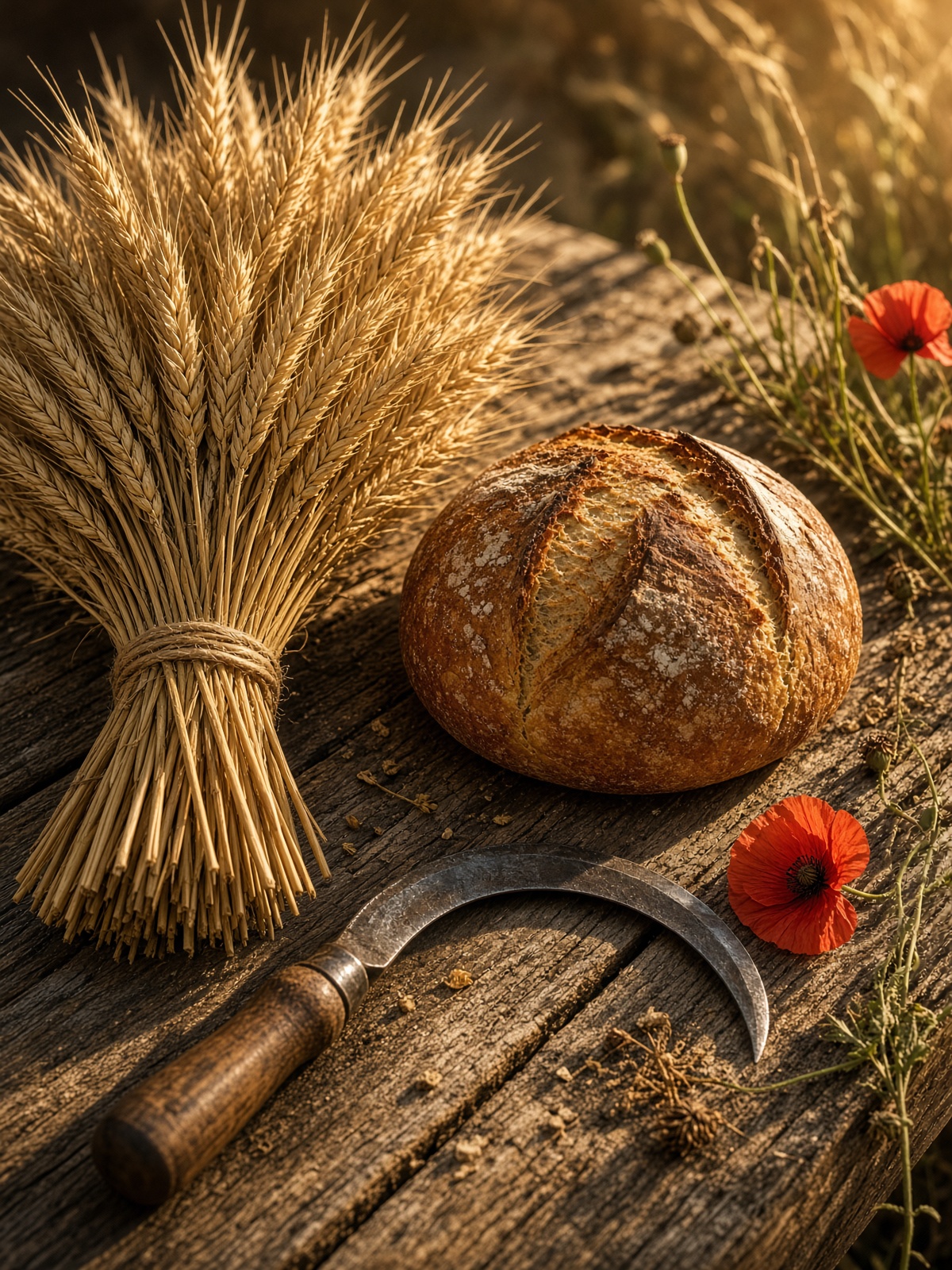
Lammas is a different word from a different culture. Old English hlāfmæsse, loaf-mass, is the first of August in the Anglo-Saxon church, when a loaf made from the new grain was blessed. Same rough season, related human gratitude, not the same feast and not the same theology. Using both names is fine if you say they are kin and not twins. The modern pagan sabbat often merges them into one wheel-stop. That merge is twentieth-century liturgy, useful, and not an ancient identity. Grain is central where grain was the staple. It is not the only first fruit on Earth. If your first edible gift is maize, mango, tomato, seaweed, sheep's milk, or a paycheck from seasonal work, that is the harvest you thank. Pretending every land is a wheat field is how a rite becomes a costume.
How it is kept now
Keep the day as a thanksgiving for labor, including labor that is not yours. Someone cut the grain or drove the truck or stocked the shelf or stood in a hot kitchen. Name them without romance about how beautiful toil is. The feast is not a sermon to overwork. Tailtiu's assembly included games and a cease of ordinary strain. Rest is traditional. If you bake, bake a small loaf, not a performance for the internet. If you cannot bake, buy the loaf and bless it by sharing it. The blessing is the eating.
Games, if you hold them, can be a walk, a card game, a swim, a child's race, a union picnic that already exists. Do not require athletic prowess as spiritual rank. Markets and fairs are in the history; a trip to a farmers' market where you can afford one thing is more honest than a themed party with no farmers. If you have no money for a market, the loaf you already own is the first fruit. Poverty is not a failed harvest. It is often a failed wage. The rite should not blame you for it.
North, south, and the weather you actually have
In the north, early August is late summer, first grain in some European fields, mid-harvest in others, and still too early in places with a short season. Look at your own farms or your own pot. A tomato that is not ripe will not ripen because the calendar said Lughnasadh. Celebrate what can be eaten and store what can be stored. If you are in a city, the harvest may be the end of a project, the first paycheck of a new job, or the blackberry behind the library. All are lawful.
In the south, a seasonal swap puts this feast around the first of February, which in some regions is not a grain harvest at all. Australian wheat, for example, is often a summer harvest nearer the end of the year, not a mirror of Irish August. A strict date-swap can still mis-time the loaf. Prefer the local first fruits even if they fall on a different sabbat, and let Lughnasadh be a smaller named day if the big harvest is later. In dry-summer climates the first fruits may come before drought closes the ground. In monsoon countries the harvest clock is the rain. Follow the rain. The god of one Irish plain is not insulted by your accuracy.
An altar that can be put away
A loaf, a knife used for bread and then washed, a cup of water, a tool of your trade, and one thing from the garden or the market that is recognizably food. Grain stalks if they are actually around. Do not buy a decorative sickle. It photographs well and means little in a flat, and it is a bad idea around children. A coin you will spend on food or put toward a bill can be the harvest token for a worker who does not touch grain. Put the altar away by eating it. An altar of bread that molds is a neglected thank-you.
If you write thanks, write them to people and to land, not only to a deity. If you address Lugh, do it as a guest in someone else's story, without claiming Irishness you do not have and without turning him into a sun-husband. If you address no one, the bread does not mind. Hospitality is the older evidence anyway: assemblies, food, games, a community breathing out.
Solitary, and with chosen family
Alone, cut a slice, butter it, and name the work of the year so far, including the work of resting. Eat at a table if you have one. If the day makes wage-work feel unseen, write one paragraph about what you did that fed someone, even if the someone was you. Solitary Lammas is not sad by default. Many historical people ate their bread in small rooms.
With chosen family, share the loaf and a game that everyone can play seated if needed. Each person may name a first fruit of their year: a skill, a crop, a boundary, a finished class, a child grown a little older, a debt paid down. No one has to have a success. 'I survived the season' is a first fruit. Give a portion away if you can, to a guest or a neighbor or a food fund, without posting the gift. Do not turn the meal into a couples' rite. Labor and friendship are the fertility of this festival. Fields do not require your romance.
The table, including if you do not cook
The skillet loaf below is a one-pan bread for people with flour and a lid. It must be cooked through. It is food, not a sacrament that replaces groceries, and not medicine. If you do not cook, a piece of bakery bread and butter is not a lesser Lammas. It is the loaf. Say thank you to the baker, at least in your head, who got up early.
If you bake and the loaf fails, eat the edible parts and call the rest tuition. Do not serve raw dough. Do not use raw kidney beans, and do not use any foraged mushroom, to seem rustic. Butter, bread, and salt are the whole doctrine. The assembly would recognize those. If the skillet is missing, a store loaf is not a cheat. It is the same thank-you with fewer dishes, and the dishes were never the god.
Correspondences, labeled as such
| Northern cultural date | 1 August, eve included. Local farms may peak earlier or later. |
| Southern seasonal choice | Often moved toward 1 February, but check your real harvest. A date-swap can still miss the crop. Follow the crop when they disagree. |
| Historical core | Irish Lughnasadh: Lugh, Tailtiu, assembly, first fruits. Anglo-Saxon Lammas: blessing of the new loaf. Kin, not twins. |
| Modern theme | Thanks for labor, a shared loaf, a game or a rest, food given onward if you can. |
| Table | Bought bread and butter is a complete feast if you do not cook. |
An original rite
Materials. A loaf you baked from the recipe below, or any bread you bought or were given · Butter, oil, or another spread you already eat, and a knife · A plate, and a second piece of bread or a coin set aside for someone else if you can spare it · A cup of potable water or tea · A note of the names you are thanking: growers, drivers, bakers, your own hands, or 'I do not know their names and the bread still arrived'
- 1Put the bread on the plate before you are starving, so the thanks is not only a rush. Sit. Speak the words of the rite.
- 2Read the names. If you address Lugh or Tailtiu, do it in one sentence of respect without inventing a sacrifice they did not ask of you. You may address no one.
- 3Cut a slice. Butter it. Eat it slowly enough to notice that it is food. This is the center of the rite.
- 4If you have a portion to pass on, set it aside in a clean wrap for a person who agreed, or put the coin where the food fund or the bill actually is. Do not leave loose bread where animals will be harmed.
- 5Name one piece of labor you will stop glorifying: unpaid extra, a job that is eating you, a standard no one can meet. Rest is part of the assembly. Plan one hour of it.
- 6Play one small game or take one short walk if your body wants it. Skip it if your body wants the chair. Both honor the feast.
- 7Wrap the remaining bread. Wash the knife. A harvest rite that ends with a dirty blade on the counter has not learned storage, and storage is the point of harvest.
This loaf had hands on it besides mine. I eat before I make a speech. First fruit is whatever actually ripened. I will not call exhaustion a virtue.
Close. Say the assembly is adjourned. Put the bread away. The names can stay on the paper until they become compost or kindling in a safe stove; they do not have to stay on the altar.
A practical action. Within the week, either rest the hour you planned or share the portion you set aside. If the harvest was money, move it to the bill before it becomes a symbol you spend by accident.
A table
- 1 cup all-purpose flour, or a mix of flour and rolled oats
- 1 teaspoon baking powder, not baking soda
- 1/4 teaspoon salt
- 1 teaspoon honey or sugar
- 1/2 cup milk or water
- 1 teaspoon oil or butter for the pan, plus a few extra oats for the top if you have them
Method
- 1Heat a small heavy pan over medium-low and add the oil or butter.
- 2Stir the flour, baking powder, salt, and honey. Add the milk or water and mix until just combined. The dough should be thick but spoonable. Do not knead it into a brick.
- 3Spoon it into the pan, shape a round about a finger thick, and cover. Cook until the bottom is browned and the top looks set, then flip carefully and cook the other side. Expect about 6 to 10 minutes a side. Split the loaf to be sure the center is cooked through, not wet or gummy. If it is not done, cover it and give it more time on low heat.
- 4Cool five minutes. Eat with butter. If you do not cook, bakery bread and butter is the same feast. Wrap leftovers and eat or refrigerate them the same day.
Questions
- Can you say how Lughnasadh and Lammas differ, and why the merge is modern?
- What is the first edible or workable fruit of your actual year, if it is not grain?
- Where are you praising labor that should instead be paid, shared, or stopped?
Sources and further reading
- Encyclopaedia Britannica, Lugnasad. Use it as a start on the August feast, then remember the Tailtiu assembly and first fruits are a richer Irish story than a single 'marriage of the god' summary.
- Encyclopaedia Britannica on the Celtic gods, for Lugh as a many-skilled figure rather than a generic sun husband.
- Encyclopaedia Britannica on Celtic festivals, for Lughnasadh as one of the four Irish quarter days.