Brigid's season, saint and goddess both
Imbolc
Imbolc is an Irish quarter day at the start of February, tied to Brigid. The saint's day and the goddess are historically tangled. Do not erase either. In the southern hemisphere, February may be high summer; let the land correct you.
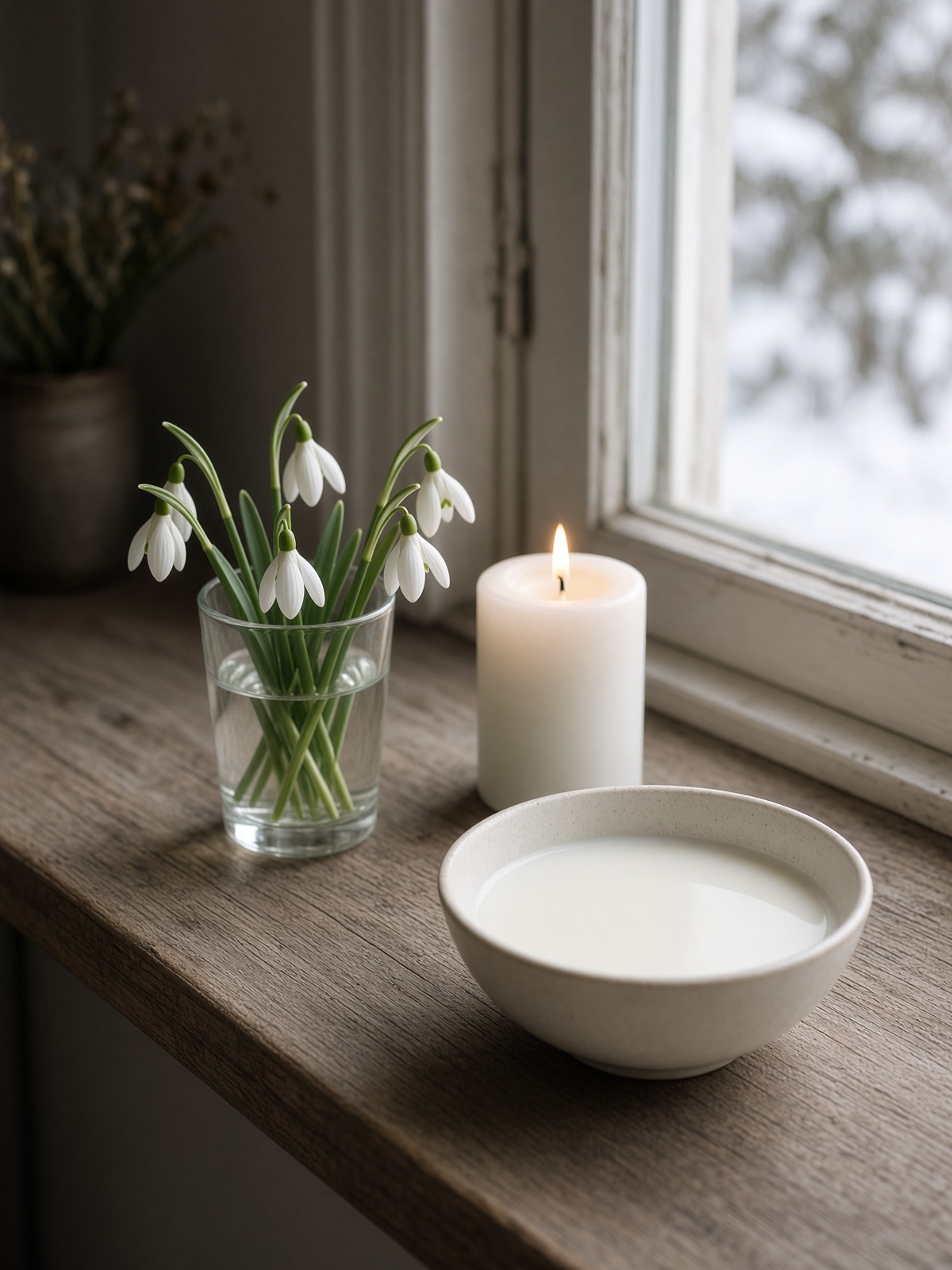
Where the feast comes from
Imbolc, around the first of February, is one of the four Irish quarter days, the midpoint of the winter half if you count from Samhain toward Bealtaine. The popular etymology connects the name to ewes' milk or to something 'in the belly,' and early glossaries are part of that tradition. Treat the etymology as likely folk knowledge rather than a settled scientific derivation. The season, in a northwestern European pastoral year, is lambing and the first hint that the dark is not the whole future. It is not yet spring in any poster sense. Mud is more honest than snowdrops if you have no snowdrops.
Brigid is the name at the center, and there is more than one Brigid to respect. Medieval Irish literature knows a Brigid of poetry, healing, and smithcraft, daughter of the Dagda in the mythographic tales, kin to the continental and British name Brigantia. The church knows St Brigid of Kildare, whose feast is the first of February, an abbess in the hagiography, a figure of enormous Irish devotion, with crosses woven from rushes, cloths left out for her blessing, and a cult that has lasted into the present. Scholars argue about how the goddess and the saint relate: continuity, replacement, shared name, Christian genius, all of these have defenders. Popular paganism often merges them. You may address the goddess, the saint, both with clean courtesy, or neither. What you may not do, in this house, is erase the Christian Brigid because she inconveniences a pagan aesthetic, or erase the pre-Christian name because a church calendar feels safer. Candlemas, the Presentation on the second of February, is a neighbor feast of candles in the Christian year, not the same rite. Weather lore about a serpent, a hedgehog, or a groundhog seeing shadow is folk custom perched on this week. It is not a doctrinal test. The American groundhog is not an Irish cow.
How it is kept now
Modern pagan Imbolc tends toward candles, milk, poetry, and a blessing of the hearth or the kitchen. Those are fair symbols if your life has a hearth, a poem, or a child who likes a candle. They are also easy to buy and easier to photograph. Prefer one act of maintenance: sew the button, wipe the stove, oil the hinge, write the actual poem, learn the safety of your own boiler. Smithcraft, if Brigid has any claim on it, looks like repair more often than like a new anvil. Healing, if she has any claim on that, looks like rest, clean water, and the clinic, not like a refusal of medicine in favor of a rhyme.
If you grew up with St Brigid's day in a Catholic or Irish household, you do not have to throw the crosses away to think pagan thoughts, and you do not have to adopt pagan language to keep the saint. If you are new to both, start by reading a little before you invent a priestess costume. A woven cross from paper or rushes, made respectfully, can be a craft without being a claim that you are Irish. If you are not of the culture, avoid performing a parody of the saint's visit for social media. Hospitality you can actually offer a guest is more in the spirit of the stories than a costume.
North, south, and the weather you actually have
In Ireland and in many northern places, the first of February is late winter: lambing in some years and some valleys, snow in others, the light noticeably longer than at Yule if you are far enough north to notice. Keep the feast there if that is your season, and call the ground frozen if it is frozen. Forcing a picnic is not Imbolc. A pot on the stove is.
In the southern hemisphere, early February is often high summer or the start of the school year, not the first milk of spring. If you swap the wheel, local Imbolc falls around the first of August, when some southern regions are actually in late winter. If you do not swap, you may keep the first of February as Brigid's feast because the saint's day is a calendar date and not a weather report, and let the prayers match the heat: water, shade, the last of the soft fruit, a blessing on the people who work outdoors. Say which choice you made. In tropical climates, ask what is newly born in the animal year you actually live beside, or skip the lamb metaphor entirely and bless the tools. A festival that only works with sheep is a festival from a sheep economy. Honor it by not pretending every city is Kildare.
An altar that can be put away
A candle or lamp, a bowl of clean potable water, a piece of bread, and one tool of your actual work: a pen, a wrench, a wooden spoon, a stethoscope, a bus pass. White cloth if it is clean, not if it is a special purchase you cannot afford. A Brigid cross only if you know what you are making and you are not mocking it. Flowers if they are local and seasonal; otherwise skip the imported snowdrops that died in a plane. Keep flame away from the spoon and the cat.
Put the altar away when the meal is done so the kitchen can be a kitchen. If you leave a cloth out overnight in the folk way of the brat Bríde, do it with intent and bring it in at morning, and do not claim it has medical power. It is a cloth. You may keep it as a reminder to be brave at the bedside or the desk. You may not sell it as a cure.
Solitary, and with chosen family
Alone, stir a pot and speak a blessing for your own actual household, including the self you find difficult. Read a poem you did not write, then one you did, even a bad one. Maintenance is the group activity you do with your future self. If the feast makes you lonely, the repair is a message to a living friend, not a more elaborate altar.
With chosen family, each person may bring a tool and a one-sentence blessing for the house, the street, or the work. No one has to speak of Brigid in the same way. A saint-honoring Christian and a goddess-honoring pagan can share bread if both agree not to recruit over the soup. Children can stir. Roommates can be blessed without being claimed as coven. This is not a romantic feast and not a fertility mandate. First milk, where it exists, is an animal fact, not a command that anyone become pregnant. Creativity, repair, and friendship are enough.
The table, including if you do not cook
The seeded milk pot is oats cooked in milk or oat milk, with butter and a few seeds. It is a weeknight food wearing a feast name. It is not medicine and not a spell. If you do not eat dairy, use a milk you tolerate or water. If you do not cook, bread and butter and a glass of milk, or just bread and butter, are enough for Imbolc. The stirring is symbolic only if stirring happens. A bought scone counts.
Do not serve raw milk as a folk flex. Use pasteurized milk unless you already know your local risks and are making an ordinary food choice rather than a ritual one. Honey is optional and is not for infants. If the month is hot where you live, a cool drink and bread can replace the hot pot without insulting the feast. The blessing is a fed household, not a particular ingredient winning a contest against your climate or your grocery store.
Correspondences, labeled as such
| Northern cultural date | 1 February, eve included. Near Candlemas, which is a neighbor and not the same feast. |
| Southern seasonal choice | Around 1 August if you want local late winter. Or 1 February kept as Brigid's calendar day, with honest summer or local weather in the rite. |
| Historical core | Irish quarter day, Brigid as goddess in medieval literature and as saint on the same date. Do not erase either. |
| Modern theme | Maintenance, poetry, a warm pot, clean water. Not a purity test. |
| Table | Bread and butter is enough if you do not cook. |
An original rite
Materials. A pot of something warm, the oats below, or bread and butter if you are not cooking · A wooden spoon, or any spoon you actually use · A candle or lamp, and a bowl of potable water · One tool from your work or home that needs a moment of care, even if the care is only wiping it · Thread, tape, or a cloth for one tiny mend, or a pen if the mend is a list of repairs you will actually schedule
- 1Clean the stove or the table enough to work. This is already the rite. Set the water bowl where it will not be knocked into the flame.
- 2If you are cooking, start the pot. Stir clockwise or not at all; the direction is not the magic. Speak the words of the rite, naming saint, goddess, both, or neither in the way you can say without contempt.
- 3While it warms, do one mend: the button, the wiped hinge, the message you have been avoiding that makes the house kinder. Keep it smaller than a renovation.
- 4Pour a little of the potable water into your own cup later, but first let the bowl be only a bowl. Do not sprinkle water on electronics. Do not claim the water is holy disinfectant. It is water.
- 5Eat, or serve, before the food goes gluey. Offer a bowl to anyone in the house who wants one, including a roommate who does not share the religion. They may refuse.
- 6Read four lines of a poem, yours or anyone's, or skip the poem if reading aloud would be unsafe or embarrassing in a bad way. Embarrassment in a good way is allowed.
- 7Wash the pot. Empty the water bowl into a plant or the drain. Put the tool back. The hearth, even if it is only a hotplate, is blessed by being usable tomorrow.
I will not erase the saint or the older name. I stir what will actually be eaten. I mend one thing my hands can mend. The first light is a chore and a mercy.
Close. Put out the flame. Say the pot is a pot again and the blessing is the ordinary cleanliness left behind. Hang any woven cross where it will not be a fire hazard, or put it away with the spoons.
A practical action. This week, schedule one repair you cannot finish in a night: the appointment, the landlord's note, the darning. If Brigid is a smith, she is in the follow-through.
A table
- 1 cup milk, oat milk, or water
- 1/3 cup rolled oats
- A pinch of salt
- 1 teaspoon butter or a drizzle of oil
- 1 teaspoon honey, or a few slices of banana
- 1 teaspoon sunflower or pumpkin seeds, or skip them if you have none
Method
- 1Put the milk or water, the oats, and the salt in a small pot.
- 2Cook over medium heat, stirring, until the oats are soft and the pot is thick, about 5 minutes. Do not walk away; oats boil over.
- 3Take the pot off the heat. Stir in the butter or oil and the honey or banana. Put the seeds on top if you are using them.
- 4Eat warm. If you do not cook, bread and butter, with or without a glass of milk, is enough. Leftover oats go in the fridge and get eaten within a day or two, reheated until hot.
Questions
- Which Brigid are you addressing, and which have you been leaving out because she complicates the story?
- What repair is small enough to finish tonight, and what repair needs a real appointment?
- If February is not spring where you live, what is the land actually doing, and how will the rite admit it?
Sources and further reading
- Encyclopaedia Britannica on Celtic festivals, including Imbolc as a quarter day of the Irish year and the glossary tradition linking it with ewes' milk.
- Encyclopaedia Britannica on the Celtic gods, including Brigid's place among Irish divine figures of poetry, healing, and craft.
- Encyclopaedia Britannica, modern Paganism, for Imbolc as a sabbat of the modern wheel rather than a survival unchanged from antiquity.